

If you’ve spent any time researching property investment in Indonesia, you’ve encountered the term PT PMA. You may also have encountered the alternative — the so-called nominee structure — and noticed that serious advisors discourage it firmly. This article explains why, and walks through the PT PMA framework in practical detail: what it is, what it allows you to do, what it costs to set up, and when it’s the right vehicle for your investment.
What PT PMA Actually Stands For
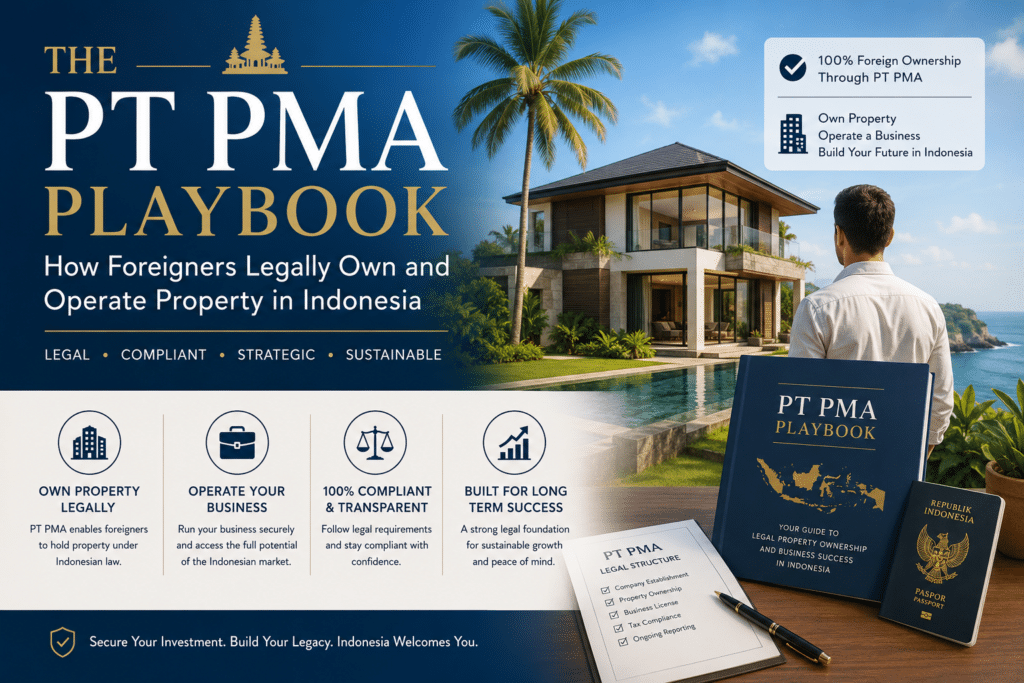
PT PMA is short for Perseroan Terbatas Penanaman Modal Asing — a Limited Liability Company with Foreign Investment. It is the legal vehicle that allows non-Indonesian individuals or entities to own and operate a business in Indonesia, including a business that owns or develops property.
Importantly, a PT PMA can hold property under Hak Guna Bangunan (HGB) — the Right to Build title — which gives the company functional ownership of buildings and improvements on land for renewable terms of up to 80 years (initial 30, plus 20 extension, plus 30 renewal). This is the closest mechanism Indonesia provides to what foreigners would recognize as building ownership.
What a PT PMA Allows You to Do
A correctly structured PT PMA permits you to:
- Hold villa or commercial property under HGB title
- Operate a legal rental business and invoice clients in IDR or foreign currency
- Employ local and foreign staff
- Open Indonesian bank accounts in the company’s name
- Access KITAS (work and residence permits) tied to your role as a director or commissioner
- Repatriate profits abroad through declared dividend distributions
In short, it is the legal infrastructure that lets a foreign investor run a real, taxable, transparent property business inside Indonesia.
The Setup Process
Establishing a PT PMA is more involved than incorporating a company in many other jurisdictions, but it is well-trodden territory. The typical process moves through several stages:
Capital declaration. Indonesia requires PT PMA companies to commit a minimum investment plan of IDR 10 billion (approximately USD 650,000 at recent rates), though paid-up capital requirements at incorporation are more modest. The investment commitment can be deployed over time into property, build costs, and operating capital.
Deed of establishment. Drafted by a notary, this document defines shareholders (a minimum of two), directors, commissioners, and the business activities the company is licensed to perform. The activities listed must align with the KBLI classification system, which dictates which business lines are open to foreign ownership.
OSS registration. The Online Single Submission system issues your business identification number (NIB) and operational permits. This has streamlined what used to be a painfully slow process.
Tax registration (NPWP). The company receives a tax identification number and begins its obligations: monthly tax filings, annual reports, and (depending on activity) VAT registration.
Bank account opening. Once the company is registered, you can open IDR and foreign currency accounts at major Indonesian banks.
The full setup, from engagement to operational status, typically runs 6–10 weeks when handled by experienced advisors.
The Tax Reality
A PT PMA is not a tax shelter — it is a legitimate operating company subject to Indonesian corporate income tax (currently 22%), VAT where applicable, employee tax obligations, and annual reporting. Properly handled, this is manageable and affordable. Improperly handled, it becomes a chronic liability.
Engaging a qualified Indonesian accountant from day one is non-negotiable. The cost is modest; the cost of getting it wrong is not.
Why Nominee Structures Are a Trap
The “nominee” structure — where an Indonesian citizen holds property title on your behalf, supported by side agreements — is widely marketed and widely regretted. Indonesian law does not recognize beneficial ownership behind a nominee. If a dispute arises, the title-holder is the legal owner. Side agreements are unenforceable in practice.
Legitimate advisors will steer you firmly away from nominee arrangements. The legal pathways available to foreign investors — leasehold and PT PMA — are robust and time-tested. There is no need to take shortcuts that leave your asset legally exposed.
When PT PMA Is the Right Choice
A PT PMA makes sense when:
- You’re acquiring property as part of a business operation (rental villa, boutique hotel, restaurant)
- You want to develop or build, not just hold
- You’re deploying meaningful capital and want HGB-titled assets
- You plan to live in Indonesia and need a KITAS pathway
- You want to operate transparently and protect your investment under Indonesian corporate law
For purely passive ownership of a single villa held over a fixed term, a long-term leasehold may be more efficient. For active investors and developers, PT PMA is the standard.
The Bigger Picture
Setting up a PT PMA is not a workaround. It is the formal mechanism Indonesia provides for foreign capital to participate in its property and business sectors. Investors who treat it as such — investing properly, accounting properly, paying tax properly — operate with full legal standing and complete protection of their assets.
That is worth far more than the perceived savings of any informal structure.
If you’d like guidance on whether PT PMA is the right vehicle for your investment plan, our legal setup advisory team can walk you through the process and connect you with vetted notaries and accountants.