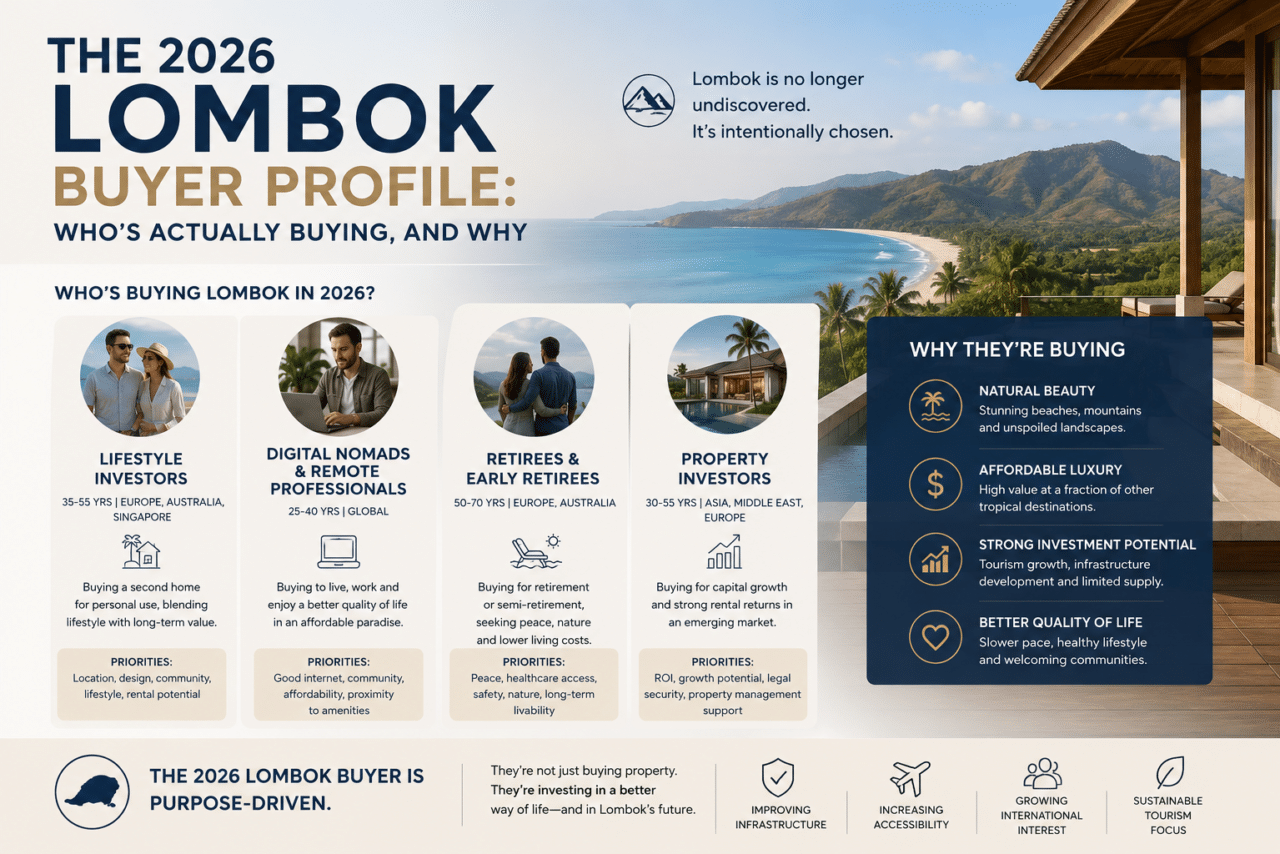

Five years ago, the foreign buyer in South Lombok was a relatively narrow demographic — surfers, early adopters, and a handful of pioneering developers. In 2026, that picture has fundamentally changed. The buyer pool has diversified, the average ticket size has climbed, and the motivations for purchase have splintered into distinct cohorts that look almost nothing like one another.
Understanding who is actually buying — and why — is useful for two reasons. If you’re a seller or developer, it tells you who you’re really marketing to. If you’re a buyer, it tells you what kind of competition you’re up against in your price band. Either way, it’s a more honest portrait of the market than the generic “international investor” framing most agents still use.
Cohort 1: The Australian Coastal Investor
The largest single national buyer cohort in South Lombok remains Australian. The geography is favorable (a direct flight from major eastern Australian cities), the surf is world-class, and Australians have a long cultural familiarity with Indonesia from decades of Bali tourism.
The Australian buyer in 2026 is not a backpacker. The typical profile is a 40–60 year old professional, often a small business owner, tradesperson, or executive, who has been visiting Lombok for years and has decided to convert a holiday habit into an asset. Average ticket size sits in the mid-six-figure USD range, and the preferred property type is a 2–3 bedroom villa near surf access in Kuta, Selong Belanak, or Are Guling.
Australian buyers tend to prioritize: walking distance to surf, a private pool, manageable maintenance, and a credible rental management option for the months they’re not personally using the villa.
Cohort 2: The Dutch and German Lifestyle Migrant
European buyers — particularly Dutch and German — are the fastest-growing cohort by percentage. The driver is partly currency, partly tax, and partly lifestyle. Northern European retirees with strong pensions and significant equity in their primary homes are looking at Lombok not as a holiday investment but as a partial relocation.
This buyer is typically older (55–70), is buying for personal use first and rental second, and is more interested in design quality, build standards, and long-term livability than yield. They often spend 4–6 months a year in residence and rent the property on a curated basis the rest of the year. Average ticket size trends higher than the Australian cohort — often into the seven-figure range for a flagship property.
Dutch and German buyers are particularly drawn to architectural integrity, material quality, and properties that signal restraint rather than excess. The “tropical luxury” aesthetic — stone, timber, limewashed walls, considered detailing — speaks directly to this cohort.
Cohort 3: The Singapore and Hong Kong Yield Investor
The Asian institutional-style investor has arrived in South Lombok in meaningful numbers. Buyers from Singapore, Hong Kong, and increasingly Kuala Lumpur are looking at Lombok property as a yield play within a regional portfolio.
This buyer is younger on average (35–55), more financially literate, and asks different questions: net yield after management fees, occupancy rate assumptions, currency hedging, exit liquidity, and capital appreciation projections. They are less interested in the lifestyle dimension and more interested in the math.
Average ticket size is variable, but this cohort is comfortable deploying meaningful capital into well-structured projects, particularly off-plan developments where the projected ROI is documented and the developer’s track record is solid.
Cohort 4: The French Sophisticate
A smaller but increasingly visible cohort: French and French-speaking buyers (Belgium, Switzerland) who are drawn to Lombok specifically because it is not Bali. This buyer values discovery, wants to be early to a market rather than late, and tends to engage deeply with local culture and aesthetics.
Average ticket size is mid-to-high. The French buyer prioritizes provenance — knowing who designed the villa, who built it, where the materials came from, and whether the project has integrity beyond its marketing.
Cohort 5: The Indonesian Domestic HNW Buyer
Often overlooked in discussions framed entirely around foreign capital: the Indonesian high-net-worth domestic buyer is increasingly active in South Lombok. Jakarta-based families, Surabaya entrepreneurs, and wealthy Bali residents looking for a second property are buying premium villas as personal retreats, family compounds, and rental investments.
This cohort matters strategically because it represents secondary market liquidity. When foreign owners eventually sell, Indonesian HNW buyers are increasingly part of the buyer pool.
What This Means for Sellers and Developers
The implication for anyone marketing property in South Lombok is that one-size-fits-all positioning is obsolete. The Australian buyer wants surf access. The Dutch buyer wants design integrity. The Singaporean wants yield documentation. The French buyer wants provenance. The Indonesian wants prestige and family practicality.
Effective marketing in 2026 segments these audiences and speaks to each in their own language — sometimes literally. A LITHOS-style flagship project is doing distinct things for distinct buyers, and the messaging that converts each cohort is specific.
What This Means for Buyers
If you’re buying in 2026, understanding which cohort you fit into clarifies what you should optimize for. A yield-driven buyer should not be paying premium for design that doesn’t translate to rental income. A lifestyle-driven buyer should not be making decisions based on yield projections that won’t materially affect their life.
Knowing your own profile is the first step in deploying capital intelligently in this market.
If you’d like to discuss which buyer profile fits your situation and how to structure your investment accordingly, we offer confidential advisory consultations.