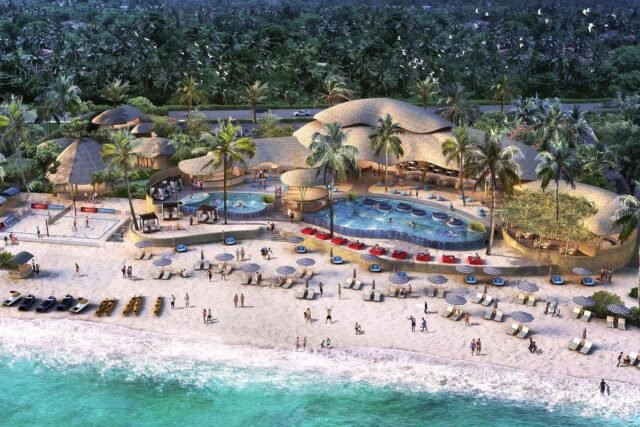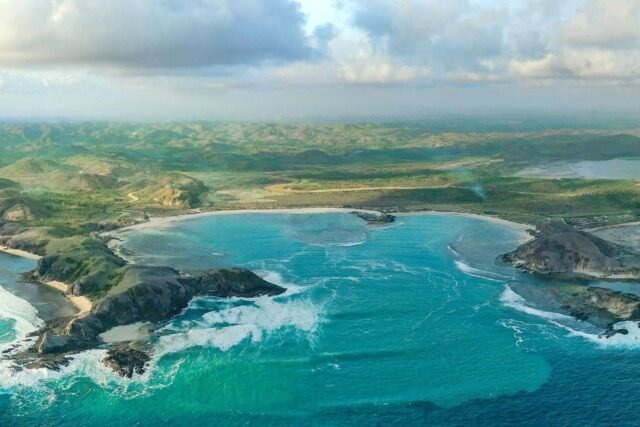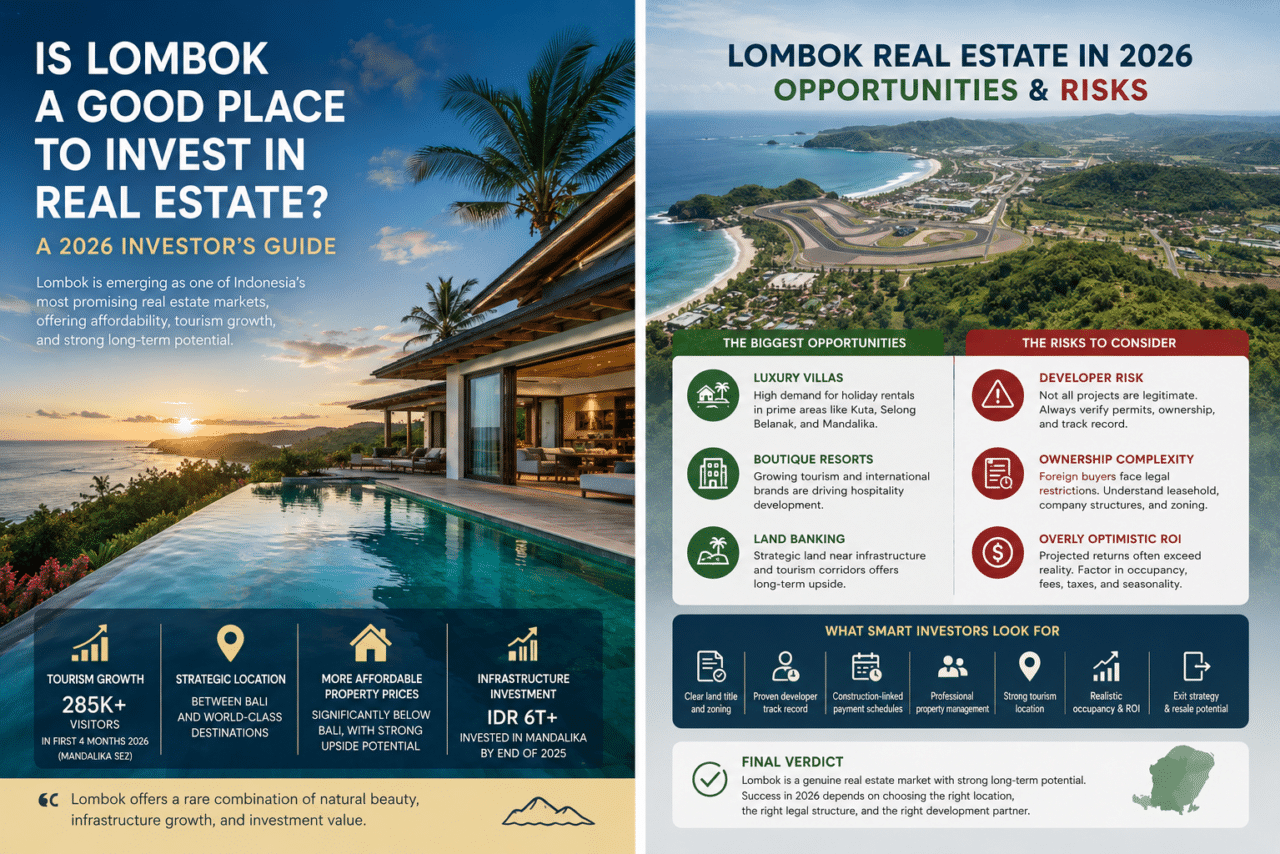

Lombok has spent the last few years shedding its reputation as a risky frontier and stepping into a new role: a credible, high-yield alternative to Bali. For investors priced out of Canggu and Uluwatu, the pitch is compelling — land at 30–50% below Bali levels, projected rental yields in the double digits, and a Special Economic Zone backed by sovereign-grade infrastructure.
But “cheaper than Bali” isn’t an investment thesis on its own. So is Lombok a good place to invest in real estate in 2026? Let’s look at the numbers, the drivers and the risks — and who this market actually suits.
The short answer
For investors with a medium-to-long horizon and an appetite for an emerging market, Lombok offers one of Southeast Asia’s most attractive risk-reward profiles right now. The fundamentals — infrastructure, tourism growth and a low price base — are genuinely strong. The catch is execution: yields and appreciation figures vary widely by source and location, and success depends heavily on buying in the right zone with the right structure and professional management.
Why Lombok is on every investor’s radar in 2026
Mandalika: government conviction you can see
The single biggest driver is the Mandalika Special Economic Zone in South Lombok. This isn’t a brochure promise — it’s backed by an Asian Infrastructure Investment Bank loan in the region of US$248 million, with major project completion targeted around mid-2026. That money has already delivered roads, water systems, utilities and regional connectivity at a scale that changes what’s buildable in the surrounding area.
When a government and multilateral lenders commit capital like that, it signals a long planning horizon — the kind of conviction individual investors can’t manufacture but can ride alongside.
A tourism engine that’s still accelerating
Mandalika is built around demand. The zone hosts the MotoGP circuit, and visitor numbers to the area have been climbing steadily — with figures around 2.8 million expected in 2026. Indonesia’s broader tourism push, expanded capacity at Lombok International Airport, new port and fast-boat connections to Bali, and marquee hospitality arrivals like Hyatt’s Samara Lombok are all funnelling more visitors — and more rental demand — into South Lombok.
Prices still well below Bali
Lombok’s core appeal remains its price gap. Land near Kuta Mandalika has been cited around IDR 350 million (~$25,000) per 100 m², with neighbouring areas lower still — a fraction of comparable Bali hotspots. That lower base is exactly what gives appreciation room to run: several market outlooks project Lombok’s capital appreciation to outperform Bali in percentage terms over the next few years, precisely because it’s starting from a lower point.
What kind of returns can investors realistically expect?
Here’s where you need a clear head, because the published figures range widely:
- Multiple 2026 outlooks point to gross rental yields of roughly 8–15% in prime South Lombok spots like Kuta and Mandalika, with professionally managed short-term-rental villas at the higher end.
- Some developers market projected yields even higher; treat the top of any range with healthy scepticism and ask to see the assumptions.
- Projected capital appreciation in beachfront and hilltop areas is frequently cited in the 10–20% range through 2026, driven by infrastructure momentum.
Two important caveats. First, every one of these numbers is a projection, not a promise — yields depend on occupancy, management quality, pricing and season. No credible developer will guarantee a return. Second, the gap between a managed, well-located villa and a poorly positioned one is enormous. The market has shifted from lifestyle holiday homes toward yield-focused, professionally managed assets — and that’s where the returns concentrate.
Where to invest in Lombok
Location discipline matters more here than almost anywhere:
- Kuta Mandalika — the demand epicentre. SEZ-driven tourism, international visibility and the strongest short-term-rental economics on the island. This is the zone where LITHOS sits.
- Selong Belanak — quieter, surf-oriented, with longer average guest stays; appeals to investors targeting a calmer market.
- Senggigi — established hospitality ecosystem in the west, closer to urban services.
For most investors chasing rental income and appreciation, the SEZ gravity around Kuta Mandalika is the clearest signal.
The risks you shouldn’t ignore
A balanced answer means naming the downsides:
- Execution risk. This is still an emerging market. Infrastructure timelines slip, and not every project delivers as marketed.
- Oversupply in segments. As capital pours in, certain villa segments can get crowded. Differentiation and management quality become decisive.
- Legal structure. Foreigners can’t own freehold; you’ll invest through leasehold, Hak Pakai or a PT PMA with HGB. Get this wrong — or worse, accept a nominee arrangement — and your “asset” may not be legally yours. (Nominee structures are not legally recognised; avoid them.)
- Due diligence gaps. Title clarity, zoning (RTRW), road access and developer track record all need verification before you commit. Lower entry prices don’t lower the diligence bar.
- Liquidity. Resale markets are thinner than Bali’s. Plan your exit before you enter.
So — is Lombok a good place to invest in real estate?
For the right investor, in 2026, yes. The combination of sovereign-grade infrastructure through the Mandalika SEZ, accelerating tourism, projected double-digit yields and a price base well below Bali makes Lombok one of the more compelling value plays in Southeast Asian property — particularly for Australian, European and US buyers who want “Bali twenty years ago” with modern connectivity.
But it rewards discipline, not optimism. The investors who do well here buy in the right zone, through a compliant structure, with professional management and realistic, projected numbers — not guaranteed ones.
That’s exactly the gap Razzaque Estates is built to close. Our LITHOS development places stone villas in the heart of the Kuta Mandalika SEZ, structured for compliant foreign ownership and built for the yield-focused, professionally managed model this market now rewards. With Phase 2 villas available before Phase 3 pricing opens, the entry window favours early movers. See the LITHOS investment details or book a consultation to run the projected numbers on a specific unit.
Frequently Asked Questions
Is Lombok a good investment in 2026? For medium-to-long-horizon investors, yes. The Mandalika SEZ, rising tourism and a low price base relative to Bali underpin strong fundamentals, with projected rental yields commonly cited around 8–15% in prime areas — though returns are never guaranteed.
What rental yield can I expect in Lombok? Prime South Lombok areas like Kuta Mandalika are frequently cited with projected gross yields of roughly 8–15%, with professionally managed short-term rentals at the higher end. Treat all figures as projections that depend on occupancy and management.
Is Lombok cheaper than Bali for property investment? Yes. Entry prices are commonly 30–50% below comparable Bali areas, which is a key reason appreciation is projected to outpace Bali in percentage terms from a lower base.
Can foreigners invest in Lombok real estate legally? Yes — through leasehold, Hak Pakai or a PT PMA holding an HGB title. Foreigners cannot hold freehold, and nominee arrangements are not legally recognised and should be avoided.
Which area of Lombok is best for investment? Kuta Mandalika leads for short-term rental demand thanks to the SEZ; Selong Belanak suits quieter surf-market plays, and Senggigi offers an established hospitality base.