
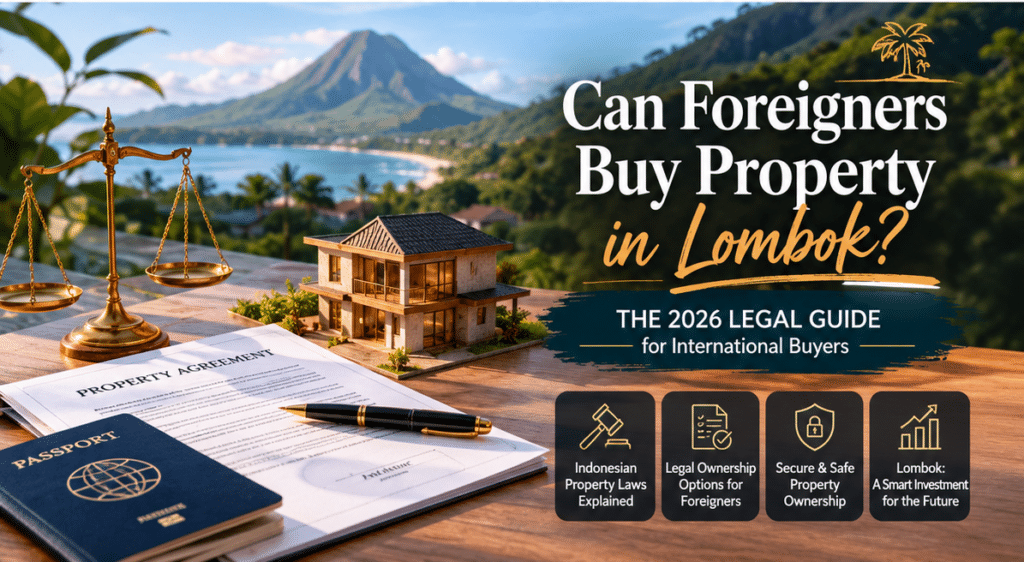
If you have fallen for Lombok’s empty surf breaks, low entry prices and the momentum building around the Mandalika Special Economic Zone, there is one question that comes before everything else: can foreigners buy property in Lombok at all?
The short answer is yes — but not in the way most people assume. Foreigners cannot hold freehold land directly anywhere in Indonesia, Lombok included. What you can do is take legal, enforceable, long-term control of property through three well-established structures. Understanding which one fits your goal is the difference between a secure asset and an expensive mistake.
This guide breaks down exactly how foreign property ownership works in Lombok in 2026, what each structure costs you in security and flexibility, and the red flags that should make you walk away from any deal.
The one rule every foreign buyer must understand first
In Indonesia, the highest form of land title is Hak Milik — freehold ownership. By law, this title is reserved exclusively for Indonesian citizens. No visa, no length of residency and no investment amount changes that. If an agent or “lawyer” tells you that you, as a foreigner, can personally hold freehold title, they are either misinformed or misleading you.
That sounds restrictive, but it is not a dead end. Indonesian law deliberately provides legal pathways for foreigners to use, build on, rent out and profit from property. The job is simply to pick the right one.
The three legal ways foreigners can hold property in Lombok
- Leasehold (Hak Sewa) — the simplest path for individual buyers
A leasehold is a long-term rental of land or a completed villa, registered for a fixed term. In Lombok, leases are commonly structured for long durations — up to 80 years — frequently with renewal or extension options written into the contract.
Leasehold is popular because it is straightforward and cost-efficient. You get the right to use, live in and rent out the property for the lease term, and in most cases you can sell or transfer the remaining lease to another buyer. The trade-off is that you do not control the underlying land outright — so the quality of your contract, and the trustworthiness of the landowner, matter enormously.
Best for: individual buyers, holiday-home owners and investors who want a clean, lower-cost entry without setting up a company.
- Hak Pakai (Right to Use) — the residential title in your own name
Hak Pakai lets a qualifying foreigner hold a usage right to a property directly in their own name, rather than through a lease or a company. To use it you generally need a valid Indonesian stay permit (KITAS or KITAP).
A few important details for 2026:
- Indonesia sets minimum property-value thresholds for foreign Hak Pakai purchases, and they vary by province. In West Nusa Tenggara (which includes Lombok), the minimum has commonly been cited in the region of Rp 2 billion. These figures are updated periodically, so always confirm the current threshold with a local notary before you commit.
- The term structure is typically an initial grant followed by renewals that can extend the total usage horizon up to 80 years.
Best for: foreigners with a residence permit buying a home for personal use.
- PT PMA with HGB — the structure built for investors and developers
A PT PMA (Perseroan Terbatas Penanaman Modal Asing) is a foreign-owned company registered under Indonesian law. The company itself can hold Hak Guna Bangunan (HGB) — the “Right to Build” title — which is the strongest title a foreign-controlled entity can obtain.
This is the structure that gives investors the most control. Under HGB, the PT PMA is registered as the title holder and has full rights to build, operate commercially, transfer, sell or split the property. A LITHOS villa in Kuta Mandalika, for example, is structured for foreign ownership through these compliant frameworks rather than informal workarounds — an HGB-based HGB 80 horizon gives investors a long, secure runway to hold and exit.
Setting up a PT PMA requires at least two shareholders and ongoing compliance, so it carries more administration and cost than a simple lease. For anyone buying to rent out, develop, or run a hospitality business, that overhead usually pays for itself in security and flexibility.
Best for: serious investors, developers and anyone running a rental or commercial operation.
The nominee “shortcut” — and why you should never use it
You will eventually hear about the nominee arrangement: putting land under an Indonesian citizen’s name on your behalf, backed by a side agreement.
Do not do it. Nominee structures are not legally recognised in Indonesia. The side agreements that supposedly protect you are widely considered unenforceable, which means the person named on the certificate is the legal owner — not you. Foreign buyers have lost properties this way. Any developer or agent who pitches a nominee structure as “safe” or “normal” is steering you toward exactly the risk this guide exists to help you avoid.
A reputable developer will only ever offer you a compliant structure: leasehold, Hak Pakai or PT PMA with HGB.
Due diligence: the checklist before you sign anything
Whichever structure you choose, the process is only as safe as your verification. Before committing:
- Verify the land certificate and confirm the title type (Hak Milik to be converted, SHM, HGB, etc.).
- Check zoning (RTRW) to confirm the land can legally be used for your intended purpose.
- Confirm legal road access and check for any encumbrances or disputes.
- Use a licensed notary (PPAT) to draft and witness the agreement — never rely on a handshake or an unregistered contract.
- Register the transaction with the National Land Agency (BPN).
- Never pay 100% upfront. Use a staged structure tied to verification and notarial milestones.
- Budget for transaction taxes. Land transfers typically attract acquisition tax (BPHTB) and other duties; confirm the exact figures with your notary and a tax advisor, as rates and treatment vary by transaction.
So, can foreigners buy property in Lombok? Yes — with the right structure
Foreigners can’t own Indonesian land outright, but you can legally and securely control Lombok property through leasehold, Hak Pakai or a PT PMA holding an HGB title. The “right” choice depends entirely on your goal: a clean holiday home, a residence in your own name, or an income-generating investment asset.
What stays constant is the discipline: a compliant structure, a licensed notary, full title verification — and a hard no to nominee arrangements.
At Razzaque Estates, every LITHOS villa in the Kuta Mandalika SEZ is structured around legally compliant foreign-ownership frameworks, with the documentation handled transparently from reservation to title. If you’re weighing up how to own in Lombok the right way, talk to our team before you sign anything.
Frequently Asked Questions
Can a foreigner own freehold (Hak Milik) land in Lombok? No. Freehold title is reserved for Indonesian citizens. Foreigners use leasehold, Hak Pakai or a PT PMA with HGB instead.
How long can a foreigner control property in Lombok? Leasehold and Hak Pakai structures can reach up to 80 years through their term and renewal options. A PT PMA holds HGB title with its own long, renewable horizon.
Do I need an Indonesian partner to buy property in Lombok? No. None of the three legal structures require you to share ownership with an Indonesian individual. Any structure that requires a local “owner” is a nominee arrangement — which is not legally recognised.
Is a nominee arrangement ever safe? No. Nominee structures are not legally recognised and expose you to severe risk, including loss of the property. Avoid them entirely.
Which structure is best for an investment villa? For rental income or development, a PT PMA holding an HGB title gives the most control and the cleanest path to transfer or sell.